
The FIFA™ World Cup is one of my favorite sporting events, but following it in real time can get messy fast.
There are schedules, standings, group-stage tiebreakers, knockout paths, scorer races, market expectations, qualification scenarios, and live match results. Each piece is available somewhere, but usually in a different place, with a different interface, and a different level of context.
I wanted something simpler: one view that could pull the tournament into focus without flattening what makes it interesting.
That’s where the World Cup tracker started.
The original goal was practical. I wanted a cleaner way to understand where the 2026 men’s tournament stood at any point in time: who was leading groups, who was likely to advance, what the bracket looked like, who was scoring, and how the projections were changing as results came in.
Over time, it became a snapshot of who might win at any given moment.
Archives For Reference
The 2026 men’s tracker is now preserved as a final archive, with group results, knockout results, match details, scorer data, team profiles, and now with an added projection performance page.
The performance page is part recap and part accountability layer. It shows how the tracker handled uncertainty, where the tournament surprised it, and how the model sharpened as the field narrowed.
The tracker made projections during the tournament, but the obvious question is: were they any good?
The answer is yes, pretty good overall.
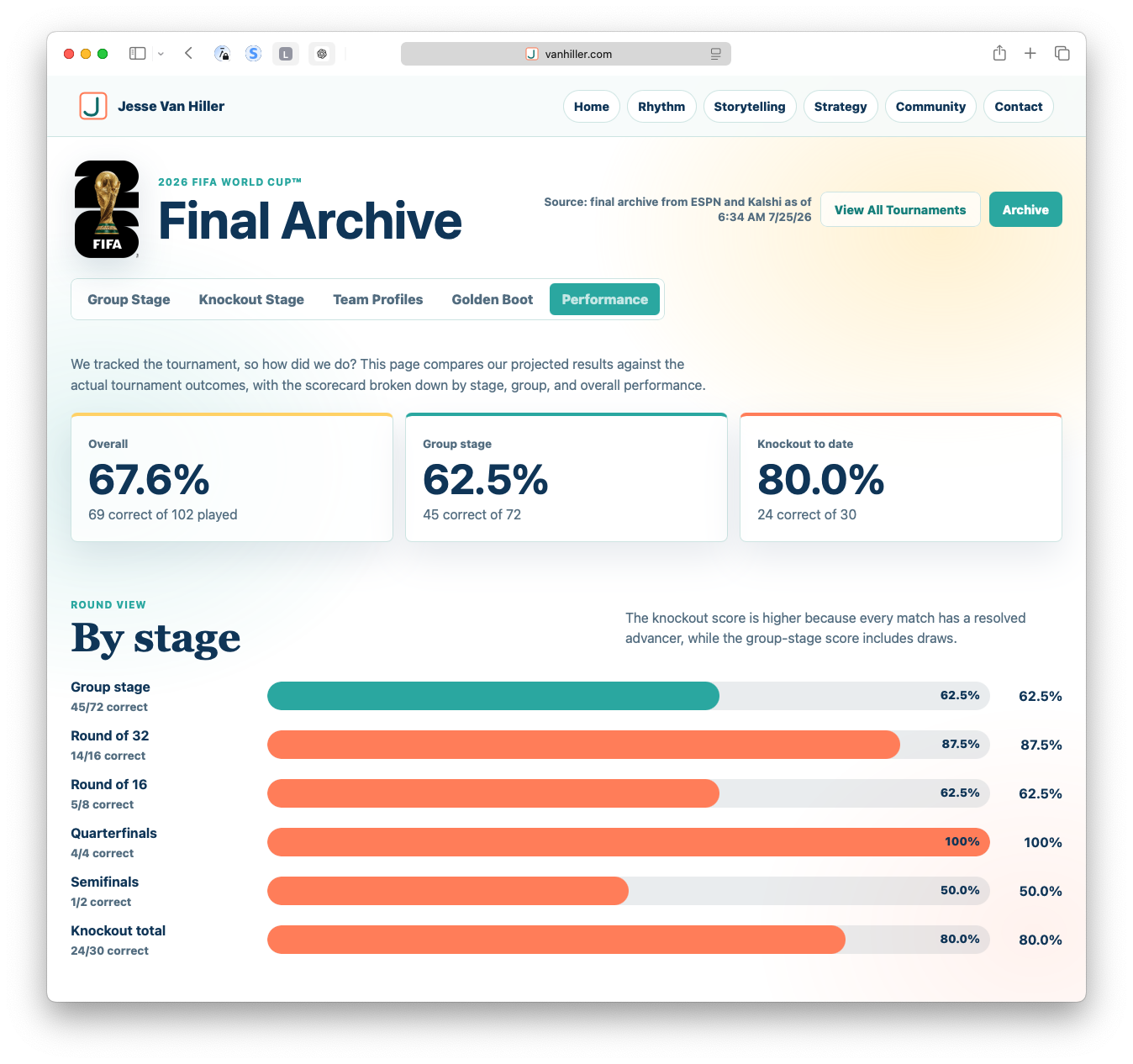
The performance view compares projected outcomes against actual tournament results. It shows where the model was right, where it missed, and how accuracy changed across the tournament. Projections are easy to make in the moment; the archive gives us a way to grade them after the fact instead of letting them float away silently.
One insight it highlighted for me was that the tournament stage alters the shape of the prediction problem. Group-stage matches can end in a win, loss, or draw, and those draws create more uncertainty in the standings and advancement paths. Knockout matches are more direct, and as a result, easier to predict: one team advances and one team does not. Once the tournament moves into elimination play, the tracker has fewer possible outcomes to account for, and the projections become more accurate as a result.
Potential New Feature: Time-Machine
I’m also considering one more archive feature: a time-machine control.
The idea would be simple. Instead of viewing only the final archive, you could jump back to a specific point in the tournament, like after the group stage or after the Round of 16, and see what the tracker believed at that moment. What did the bracket look like then? Who looked most likely to win? Which teams were rising or fading? I’m not sure yet whether that becomes a full feature, but I’m curious to see if even a small version creates interest.
For now, the project has a clear shape: live tournament coverage while the matches are happening, then a permanent archive once the final whistle blows.
Next Stop, Brazil
Next up is the 2027 FIFA Women’s World Cup in Brazil.
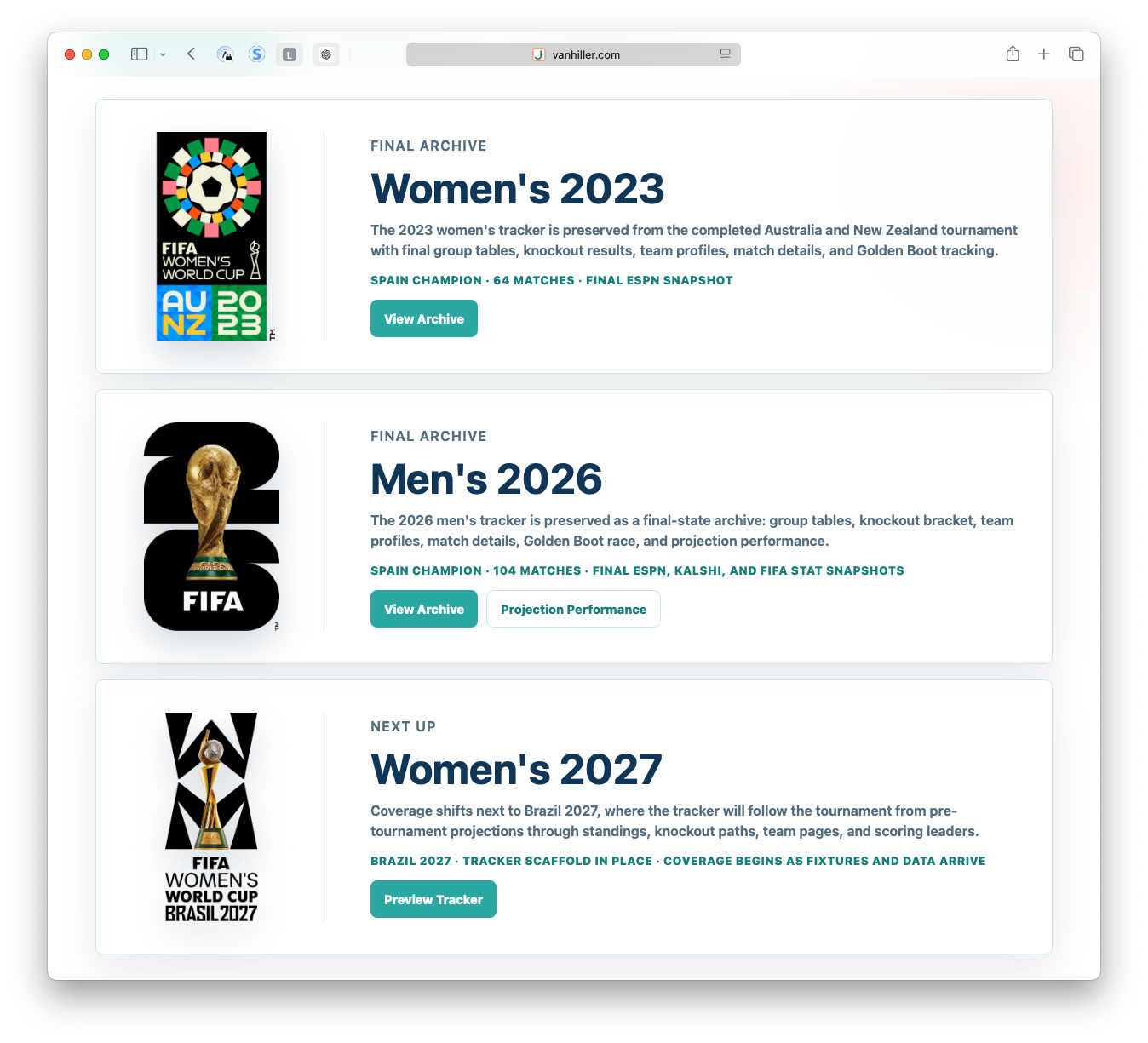
I've created a tracker for the 2027 women's tournament, but because it does not have any data yet, save the host Brazil as a known participant, I also added a 2023 women’s World Cup archive for comparison. That gives the project another completed tournament to study, with a different format, different teams, and a different competitive shape.
The women's tournament, through 2027, has 32 teams, unlike the men's tournament, which now has 48 teams and maybe more in the future. That means it does not include any complex third-place tracking yet. However, in 2031 that appears to be changing, and the women's tournament will also move to a 48-team format.
For the 2027 women's edition, once qualification is complete and the schedule is posted, the tracker will start filling in: groups, matchups, standings, projections, scoring, team profiles, and the path toward the trophy.
Who Will Claim The Title In Brazil?
There’s a lot to look forward to. Spain enter the cycle as the reigning world champions and the top-ranked team in the world. The USWNT are right behind them at number two, chasing another title and looking to restore their standing as a top-tier nation after last tournament's early exit, their first time not finishing in the top three.
Every supporter will have a reason to come back once the tournament picture starts to form and follow whether their home nation made it, whether it can emerge from group play into the knockout round, and whether the tracker predicts their team has a real path to the final.
So come back soon and let's do it again in 2027!