
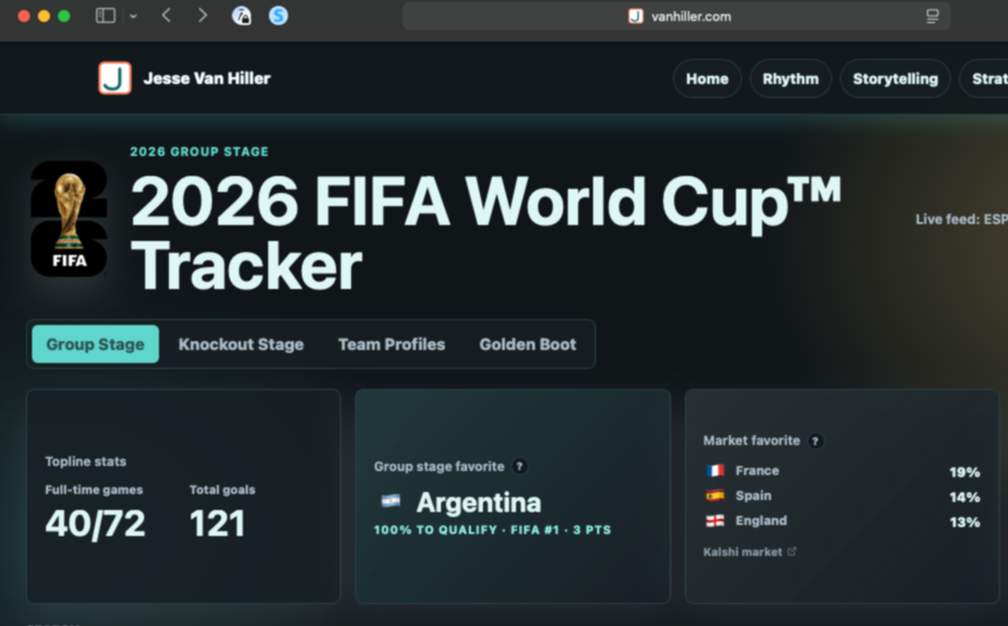
Building a FIFA World Cup(tm) tracker started as a fan project, but it quickly became something else: a working example of how product work changes when AI becomes part of the build loop.
Read more about the process and the results, and see the tracker here.
The interesting part was not simply that Codex could write code. That matters, of course. A project that might normally represent a solid week of senior frontend and product engineering effort became possible through an iterative conversation. But speed was only the surface-level change.
The deeper change was proximity.
As a product manager, I am used to describing intent, shaping requirements, reviewing implementation, finding gaps, clarifying edge cases, and trying to keep the experience coherent as a product moves from idea to execution. In a traditional workflow, those steps often travel across roles, tickets, meetings, handoffs, interpretations, and delays. Some of that structure is necessary, especially at scale. But every handoff introduces distance.
With Codex, the distance collapsed.
I could describe what I wanted, see a working version, test it, find the flaw, revise the behavior, and immediately inspect the next version. That did not make the work effortless. In some ways, it made the product work more intense. The faster the system could produce, the more important it became to know what good looked like.
The app needed more than features. It needed coherence.
Groups, teams, match identities, live scores, standings, scorer data, third-place qualification rules, knockout projections, and market comparisons all had to work from the same underlying model. A small mistake in one place could ripple across the whole experience. Codex could help create the structure, but I still had to notice when the structure was wrong.
That became the real product loop: define the intent, inspect the output, challenge the assumptions, test the edge cases, and tighten the experience.
This is where AI changes the role of the product person. It does not remove product thinking. It makes product thinking more continuous. Instead of writing a requirement and waiting for the next checkpoint, the product manager can stay inside the making of the thing. The work becomes less about passing instructions downstream and more about steering a live system towards an end product.
There is a temptation to describe this as “non-engineers can now build software.” That is partly true, but it is too small. The more meaningful shift is that people with strong product judgment can now explore implementation directly. They can test whether an idea holds together before it becomes a roadmap item, a funded initiative, or a team dependency. They can move from “wouldn’t it be useful if…” to a working artifact that exposes the real questions.
That changes discovery. It changes prototyping. It changes communication. It changes the evidence a product person can bring into a conversation.
It also changes the burden.
When the tool can generate quickly, the human has to evaluate quickly. Not casually. Rigorously. Does the logic hold? Does the interface explain itself? Does the experience work on a phone? Are the data assumptions valid? What breaks when the tournament state changes? What happens when the user arrives cold? What is being hidden, overemphasized, or made confusing?
AI did not make me less responsible for the product, it made me more responsible.
That is the confluence I am trying to understand. Product management and AI are not simply overlapping because product managers can now prompt tools. They are converging because the act of shaping software is becoming more fluid. Intent, design, implementation, testing, and iteration can happen closer together than they used to.
The World Cup tracker is a small example. It is not an enterprise platform. It is not a moonshot. It is a fan tool built around a tournament I love. But that is part of why it was useful as a learning object. It was small enough to build quickly and complex enough to reveal the pattern.
The future of product work may not be defined by whether AI replaces a role. It may be defined by how much distance remains between seeing a need, shaping a response, and putting something useful into the world.